
Overview
Most people diagnosed with Friedreich ataxia are concerned about their communication, rating speech one of the most important features of the disease requiring treatment (Food and Drug Administration (FDA) Externally-led Patient-Focused Drug Development Meeting, 2017). Dysarthria and dysphonia are highly prevalent in hereditary ataxia, worsening with disease progression. Impairments impact all speech subsystems rendering speech slow, unclear and difficult to understand.
Redenlab’s speech tests are designed to enhance a sponsor’s ability to make decisions about the efficacy of their therapies. We use objective markers of speech to capture change in disease and communication, adding value to trial clinical endpoints.

Enhanced assessment for ataxia clinical trials
Decades of research experience
Redenlab’s data capture and analysis tools capitalize on decades of research and experience in analyzing speech, created by a dedicated clinical science team.
Designed for adults and children
We understand the difference of early monitoring and have designed our tools to be flexible and easy to use on individuals of all ages and abilities.
Key opinion leaders in the field
Redenlab scientists are leaders in communication assessment, with globally recognised expertise in hereditary ataxias. Their team continue to work consumers in specialist clinics for Friedreich ataxia and Ataxia Telangiectasia.
Extensive historical dataset
Redenlab has an extensive dataset of historical speech data in Friedreich ataxia and spinocerebellar ataxia that is available for comparison against your clinical trial data, enabling a more accurate comparison between treatment and control groups.
Purpose built algorithms
Speech and language phenotypes manifest in different ways based on underlying neuropathology. Redenlab draw from their existing datasets, theoretical and clinical knowledge of ataxia and statistical expertise to build algorithms specific to key components of communication.
Sensitive to pathology
Redenlab’s speech features have proven links to disease progression, underlying genetic profiles and associated domains like cognition.
Redenlab Ataxia experience
0
SITES
0+
PATIENTS
0
LANGUAGES
0+
CLINICAL TRIALS
0+
NATURAL HISTORY STUDIES
Further reading

Phase 2a/b randomised placebo-controlled dose-escalation trial of triheptanoin for ataxia-telangiectasia
A new clinical trial has found early evidence that a metabolic therapy could improve outcomes for people with A-T, a rare and complex neurodegenerative disease with no approved treatment.

International Congress for Ataxia Research 2024
Redenlab is excited to announce that Prof. Adam Vogel will be speaking at the upcoming International Congress for Ataxia Research in London on November 14,…

The role of verbal fluency in the cerebellar cognitive affective syndrome scale in Friedreich Ataxia
Redenlab’s CEO, Adam Vogel, co-wrote “The Role of Verbal Fluency in the Cerebellar Cognitive Affective Syndrome Scale in Friedreich Ataxia” with Louise Corben, Hiba Bilal,…

Redenlab partners with BDCRC to support new NIH-funded Batten disease research
A newly formed research network focused on Batten disease, a rare and inherited brain disorder that primarily affects children, has received funding from the U.S. National Institutes of Health (NIH) to accelerate clinical research and prepare for future treatment trials.
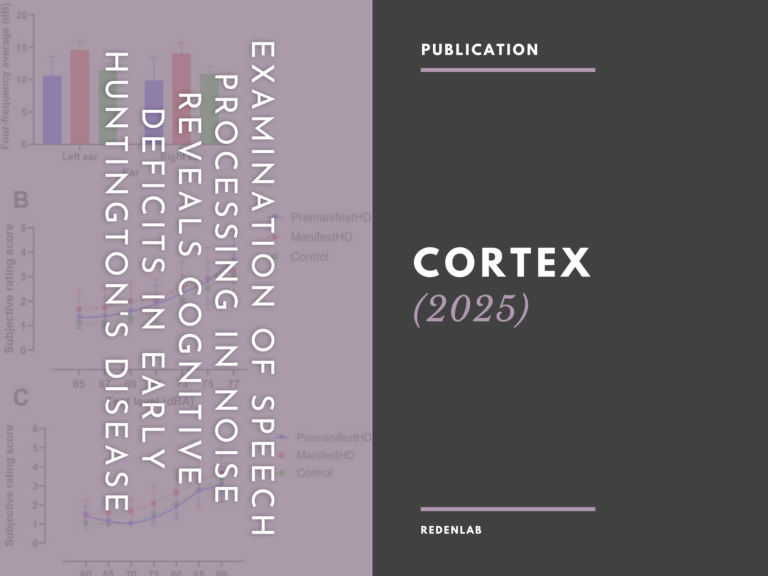
Examination of speech processing in noise reveals cognitive deficits in early Huntington's disease
Struggling to follow a conversation in noise could be more than just annoying, it might signal early cognitive issues in Huntington’s Disease.

Redenlab awarded $2.5M to scale AI-driven speech biomarkers for dementia detection
Receiving the CUREator+ Dementia & Cognitive Decline funding marks a meaningful milestone in our journey to transform how we measure and monitor cognitive health.